


Powering up South Africa's EV Future- ChrisnelSA

Share this Page


ChrisnelSA has invested heavily to bring electric and hybrid training to South Africa, and leverages being the only IMI-accredited centre in the region to boost EV skills.
South Africa’s first IMI accredited electric and hybrid training centre sits in Pretoria, but its ambitions stretch far beyond its training bays. ChrisnelSA – a business that began life as a two-man operation in Johannesburg – has evolved into one of the most forward-thinking automotive training providers on the continent.
Today it stands at the forefront of a national shift towards electrification preparing technicians, school learners and industry professionals for a future that’s arriving faster than many expected. The company’s journey into EV training didn’t happen overnight.
Founded in 2015, the business originally specialised in quality control and containment work for major OEMs. Its reputation grew steadily, leading to contracts with BMW, Toyota, Mercedes-Benz and others. But as the automotive landscape changed, and as more competitors entered the quality space, the leadership team began asking a bigger question: what comes next?
The answer was electrification. Years before EVs became a mainstream talking point in South Africa, the company was researching international standards, exploring partnerships in Europe and the UK, and considering how to bring world-class EV training to a country with a significant skills gap. After COVID the plan accelerated. Securing the right equipment, building a centre capable of delivering IMI-accredited EV and HEV qualifications meant ChrisnelSA could deliver courses and training that met global standards.
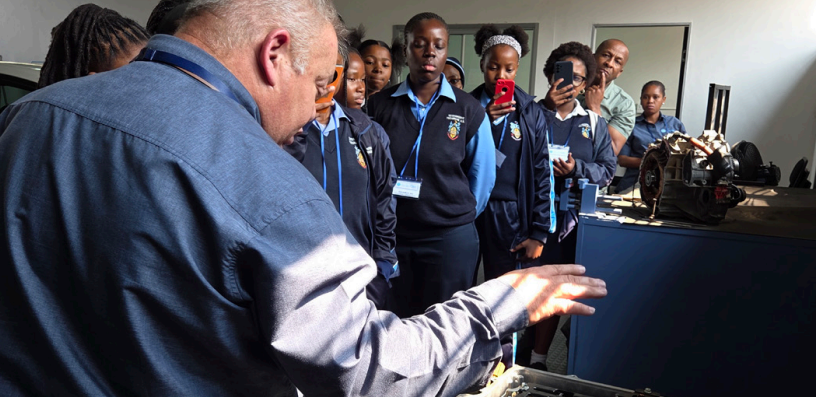
Today the Pretoria centre houses a BMW i3, a Toyota Prius, Lucas-Nülle simulators, specialist PPE, diagnostic tools and a dedicated EV workshop. A second site focuses on school-level education, introducing younger learners to greener technologies and helping build a pipeline of future technicians. Together these facilities form a unique ecosystem – one that blends international best practice with local ambition.
MotorPro spoke with Sarish Ramlall AMIMI and Jacques Zietsman AMIMI, both EV and HEV Training Facilitators, and Cecilia B, Training Centre Coordinator, to learn how the centre came to life, who it serves and why the IMI was the natural partner for its vision.
How did ChrisnelSA evolve into an EV and hybrid training centre?
Cecilia: ChrisnelSA started as a quality control company founded by Nelson Bassog and his colleague Chris – that’s where the name comes from. They began with one customer and a tiny office in Johannesburg East, but their work ethic and reputation helped them secure bigger contracts. Over time they supported OEMs with sorting, containment and quality solutions.
Around 2015 they realised the quality space was becoming crowded and started asking what the next frontier would be. Electrification was the answer. Years were spent researching EV training, connecting with partners in Europe and the UK, and exploring how to bring international standards to South Africa. After COVID the business pushed ahead aggressively – investing to build a centre that could genuinely impact skills development here.
"We have a second centre that's equipped with tools designed to introduce younger learners to greener technologies"
What facilities do you have for EV and hybrid training?
Sarish: Our IMI centre is built exactly to IMI specifications. Everything is aligned with international standards. We also have a second centre focused on school-level education. It’s equipped with simulators and tools designed to introduce younger learners to greener technologies. It falls outside the IMI curriculum but it supports our wider mission of building awareness and interest from an early age.
Why choose the IMI as your accreditation partner?
Jacques: Before joining ChrisnelSA I was trying to find EV training myself — and there was nothing available in South Africa. I even contacted people involved in early EV projects in Cape Town, and they couldn’t help. When I met Bassog he was already working with the IMI. The IMI’s global reach was a major factor. Its qualifications are recognised internationally, which matters in a country where many technicians look for opportunities abroad. The IMI also brings credibility, structure and quality assurance. People want training that means something – not a quick certificate.
What levels of training do you currently offer?
Jacques: We deliver IMI Levels 1 to 3, and Level 4 is coming later this year. There’s growing interest in the higher levels now that electrification is gaining momentum in South Africa.
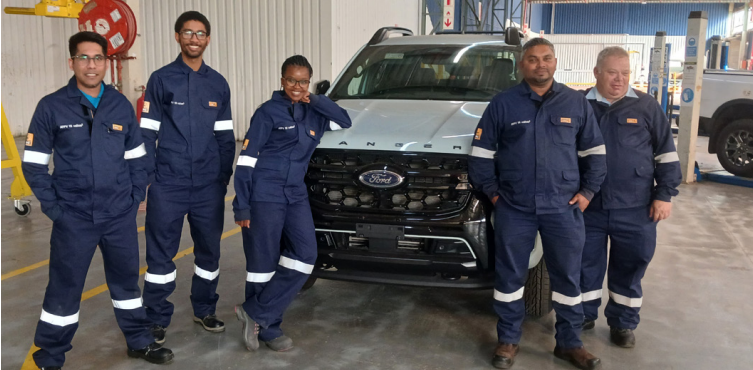
Who’s coming through the doors and what motivates them?
Sarish: It’s a real mix. About half are funded by their employers, and half pay privately. We see technicians from independent workshops, dealership staff, fleet teams and individuals who want to futureproof their careers. Jacques: Most arrive with lots of questions – especially about EV fires, because that’s what they see online. Once we take them through the IMI safety processes they realise EVs are safe and familiar. The drivetrain is different, but much of the vehicle is the same.
Have numbers increased since opening in 2024?
Cecilia: Yes, significantly. At first people were hesitant because EVs are still new here. But OEMs understood the need immediately. As we engaged with government bodies, workshops and service centres, interest grew. We now have training scheduled every month, and even international candidates – including one from the DRC – are coming to complete the full IMI pathway.
What challenges do you face in delivering training?
Sarish: South Africa is diverse, and English isn’t everyone’s first language. There’s also a wide skills and education gap. Some candidates need more support, especially with technical terminology. We overcome this with strong visuals, demonstrations, videos and hands-on practice. It makes the learning accessible for everyone.
“The Automotive Industry here is huge, but young people aren't always aware of the opportunities. We want to change that."
You place a strong emphasis on school outreach – why is that important?
Sarish: The automotive industry here is huge – Ford, BMW, Mercedes, Toyota, VW, Volvo, Scania – but young people aren’t always aware of the opportunities. We want to change that. Cecilia: South Africa has socio-economic challenges, so training must bring real value. Young people are enthusiastic when they see EVs up close. They have ideas, solutions and energy. They’re the ones who will shape how electrification fits into our context, from public transport to community mobility.
Where do you see the centre in the next few years?
Sarish: We want to become a national and international-level centre, a hub for South Africa and the wider region. We’re already working with education departments to help shape future curricula. Our goal is to build a pipeline: school learners, apprentices, technicians, engineers – all equipped for a greener automotive future.
Find out how to become an IMI approved centre and help train automotive professionals of the future.