


Powering Performance Naturally

Share this Page


The performance problem
Is “performance” a word that gets people excited? In our experience, this depends on how and where the word is used. “Performance Management” is a phrase that is often met with boredom at best, and fear at worst. If we are serious about driving results by helping people to perform at work, we need to change this.
You may work in an organisation where performance reviews are embedded in the way everyone works, you may work in a more informal organisation where performance is driven and discussed in a much more fluid way. You may work for yourself and be very aware of your own performance, without having anyone to review it with you.
It doesn’t matter what you’re used to, performance should matter to everyone at work and there are great ways and disastrous ways to try and make it happen.
Performance = Value
All organisations exist to provide value, either through what they sell or the services they provide to others.
People are the best generators of value around. What they do every day makes the organisation move. When we have conversations with our people about how they are performing, we are therefore talking about the value they generate.
A productive performance conversation might also include the value they feel they are getting from their work.
What does it look like in this industry? We should remember that the automotive sector has in many ways been a leader in the field of performance. Organisations and experts within the sector have created very powerful methods of measuring and driving performance. Here’s a clue though as to why it often goes wrong.
“Because people make our automobiles, nothing gets started until we train and educate our people”.
- Eiji Toyoda
This quote from a former president and chair of the Toyota Motor Corporation highlights an important fact – these systems are there to help people perform. If they don’t put people first, what are they doing?
Where it goes wrong
So the idea of performance conversations must be a good thing. Do they always lead to better results? Do they inspire people to perform better?
This has been researched by many highly reputable organisations. Gallup is one, and their findings are that in most cases it doesn’t work.
According to Gallup , only 14% of employees believe their performance reviews inspire them to improve. They are saying that, in practice, performance reviews are broken. And from our own observations around the many organisations we are involved with, we’d mostly agree.
Why do we think this is? We’ve looked further into the research and found several reasons for this
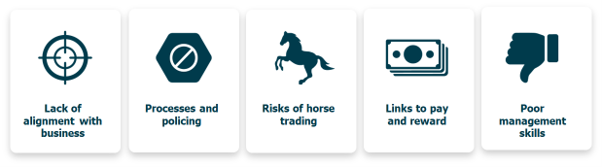
People are more likely to perform well when it gives them a sense of purpose - that’s well established by people who’ve looked at the psychology of work. If what they do makes a real contribution and they can see it, that makes a difference.
Conversely if they are working to goals that have nothing to do with the success of the organisation, or not working to goals at all, of course the whole thing is pointless.
When organisations mandate people to have performance reviews and task managers with doing them, guess what happens? At best, they get done because they are a task which needs completing, not something that people see as adding valuing – they do it to get it done, not to drive performance. And some people find reasons not to do it.
When they are done well, performance conversations are genuinely about performance and how it might improve. When done badly, particularly where people use rating scales – “you’re a 5 out of 5 for this and a 3 out of 5 for that…”, it promotes horse trading. I’ll agree to be marked down on something if I can get something else back for it.
It is reasonable to link performance to pay and reward – it gives people reasons to do more. The problem is the way this is handled – when pay and reward become the only end goal in the conversation, it can take attention away from performance. We were once tasked with briefing a series of retail managers on how they could use their new mystery shopping programme to drive sales volumes.
Because their bonuses were dependent on their mystery shopping scores, they chose not listen to anything about the programme, they just kept asking how they could cheat the results to earn more.
And much of this can be overcome if the manager running the review is well prepared and suitably skilled in making the conversation work. The problems increase when they don’t have these skills.
The employee should be at the centre of this. If the manager can see it from their point of view and think through how it works for them, they can create a positive and meaningful experience. How many performance review systems are genuinely designed with the employee in mind?
When it is done well
There’s a really positive side to this. A highly competent manager we worked with had to deal with two seriously underperforming employees within the space of six months.
They were regularly talking about where the performance was and where it needed to be, in a very positive way. They tried lots of helpful solutions to change things. When neither employee improved, they had to have the difficult conversations.
Only they weren’t that difficult because neither employee experienced the shock that so often goes with these types of meetings. They were prepared in their own minds and understood the reason for the decision. It’s never nice; done well it doesn’t have to be horrible.
Another example comes from Abcam, a life sciences company which has something very much in common with many automotive operations. Most of their line managers are technical specialists, not people who have a background where their people skills have been at the forefront.
Before 2019 they had a traditional, formal performance review process. And lots of problems, including poor staff turnover, low employee engagement and very few people reporting that they had been set performance goals or given feedback from their manager.
They introduced a programme called Performance with Purpose, which was about getting rid of the mandated process and training managers to have a continual, meaningful dialogue with their people about things that mattered. Including performance.
At first, it didn’t feel natural for a lot of people. So they kept doing it until it became part of the culture.
And they got some great results – significant improvement in staff retention, engagement, goal setting and feedback.
We like the simplicity of this example. We believe that providing people with the right tools can make performance conversations easier and more valuable.
Fact–Judgement: A tool for preparation performance conversations.
It is widely understood that when you have performance conversations, you should stick to the facts. The problem is, when the facts just say that something is wrong, how do you help the employee concerned to decide what they can do about it? You can ask them, and if they have a great answer, then you can use it.
What if they are looking for advice and guidance from their more experienced manager because they genuinely don’t have the answer?
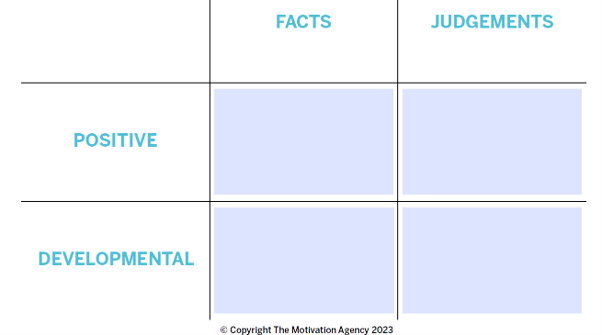
The fact-judgement grid is a very simple and practical technique that is used to kick off the process of solving a performance problem.
Ultimately, assessment and performance management are about the facts – the business results are what they are. However, ensuring competency is also about the reasons behind these results, and this might be less factual – there has to be an element of value judgement. You might believe that a salesperson is not always following the sales process or asking the right questions or following up at the right time – but do you know this to be 100% true?
It doesn’t matter if you don’t. In performance management, you sometimes have to use judgements as well as facts. You might think that a salesperson has a fear of asking for the business – this is definitely a matter of judgement unless they have told you it is true. But you must use this judgement as it could help you to help that person perform better if you discuss it openly. The difference is about how you handle facts and judgements.
In a development conversation, you should state facts that you know to be true, with confidence and make use of any evidence you have.
“Your sales this month were £3,500 – which is 30% below target.”
With judgements, you should make it clear that you are putting a view forward and want to know what they think – for example by asking questions:
“I am wondering if you find the sales process difficult – what do you think?”
This is highly productive when it is done well – a judgement can be the start of a very productive conversation and making it clear that it is an opinion or suggesting makes it non-threatening.
The grid can be used when you have identified a problem with performance. The idea is that it helps you think carefully through the following things:
- Developmental facts – the crux of the problem. The clear information that tells you that something is not working well and any other clear information you can use to understand the reasons for this.
- Positive facts – anything that you can use to show that there are positive aspects to a person’s performance and help them to build on these and sustain them. (In a difficult conversation, these may also be useful to help provide some positive feedback to motivate the individual).
Developmental judgements – possible reasons (in your judgement only at this stage) for poor performance. Positive judgements – ideas you may have about things that the individual does well or could achieve – that would be useful to explore with them. As judgements are aired openly and discussed, the following can happen:
- They can be moved across and become facts, where evidence is found or where both parties agree them to be true based on observation
- They can remain as judgements and the two parties can agree whether to differ on them or to continue to use them as a basis for open discussion
- They can be discounted as invalid and removed from the grid, which eliminates a possible cause for an issue and enables other options to be focused on.
If, for example, a technician is not as productive as they should be because they are taking longer than the standard time to do jobs, why is this? You may have a stat on their productivity, and you may believe that they have fears about the quality of their work. If exploring this idea leads to you agreeing with them that there’s something else causing the problem, then this judgement - fears around quality – is discarded. If it turns out to be true, it becomes a fact and you can work together on what can be done about it.
Make the conversation continual and focused.
There’s lot in this topic and it keeps experts busy, trying to find new, simpler, better ways to help people perform.
At its most basic, it comes down to two things.
- Performance conversations are most effective when they are continual conversations, addressing performance in the moment, not just happening onceyear.
- They lead to better results when they genuinely look at the value the employee is giving (and the value they get) and how these can be maintained or improved
When they are like this, there are no doubts, no false hopes, no surprise, and the employee is already prepared for the good or bad news.
No amount of processes or rules can substitute for a good manager doing performance conversations well and making it a natural part of their relationship with their team members. When this is done well, great performance follows.
The Motivation Agency are at https://themotivationagency.co.uk/